
Handcrafted Levels vs Player-Created Worlds
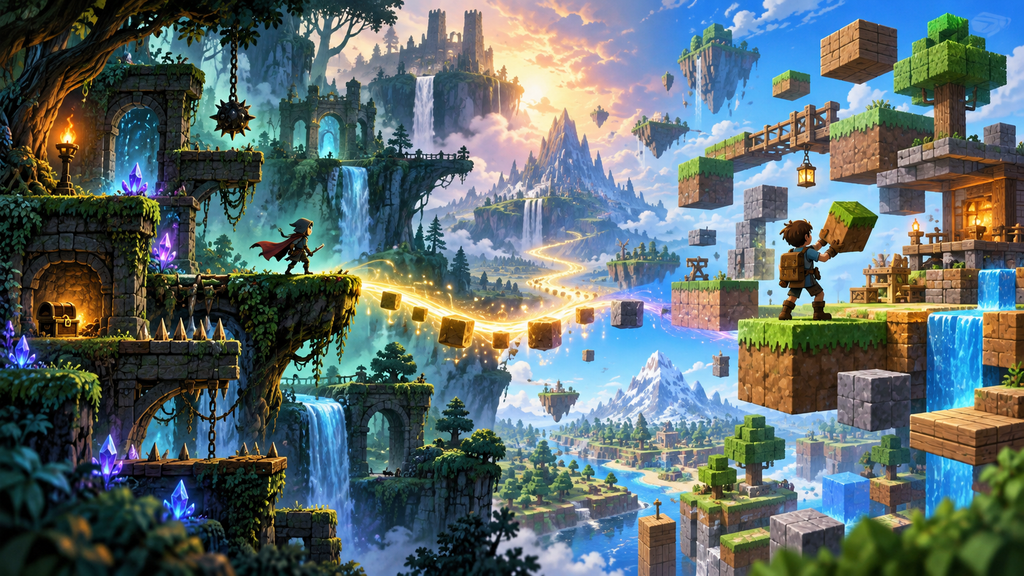
Games can hold our attention in very different ways. A carefully designed platformer may guide players through a fixed sequence of challenges, while a sandbox title can hand them a set of tools and let them decide what to do next. One approach is built around the developer’s vision; the other grows through the imagination of its community.
Neither model is automatically better. Handcrafted levels and player-created worlds simply offer different kinds of enjoyment. Understanding how they work helps explain why a focused 2D adventure can feel just as rewarding as a huge online platform filled with thousands of experiences.
What Makes a Handcrafted Level Special?
A handcrafted level is designed deliberately from beginning to end. Developers choose where the player starts, which obstacles appear first, where enemies are placed, and when a secret path becomes visible. Even small details—such as the distance between two platforms or the timing of a moving hazard—can influence how the level feels.
This approach is especially effective in side-scrolling action games. The designer can introduce one mechanic in a safe area, test it in a more difficult situation, and then combine it with earlier ideas. The result is a learning curve that feels natural rather than random.
Games such as Max the Elf also show how visual style supports level design. Hand-drawn environments, distinctive enemies, hidden areas, and changing challenges can give every stage its own identity. Players are not only moving toward the finish line; they are reading the environment and learning how its parts fit together.
Developers Control Pacing and Difficulty
In a handcrafted game, the developer acts like a director. Quiet sections give players time to explore, while combat encounters increase the pressure. A difficult jump might appear after a checkpoint, and a powerful enemy may be introduced only after the player understands the basic controls.
Good pacing creates a rhythm of tension and relief. If every moment is difficult, the game becomes exhausting. If nothing demands attention, it becomes forgettable. Deliberate level design lets creators balance those extremes and build toward memorable moments, including boss battles or major discoveries.
This control also makes progression feel meaningful. New abilities can open routes that were previously unreachable, encouraging players to revisit older areas. The world may be fixed, but the player’s growing knowledge and skill can make it feel different each time.
Hidden Areas Reward Curiosity
Secrets are one of the strongest tools in handcrafted design. A suspicious wall, an unusual platform, or an enemy guarding an apparently empty corner can suggest that something is hidden nearby. Finding a secret feels satisfying because the player has noticed a clue that could easily have been missed.
What Are Player-Created Worlds?
Player-created worlds take a different approach. Instead of offering one finished campaign, platforms such as Roblox provide creation tools that allow community members to build their own environments, rules, objectives, and social spaces. One experience might be a racing game, another a role-playing world, and another a difficult obstacle course.
The main attraction is variety. Players can move between genres without leaving the same platform, while creators can publish updates in response to community feedback. Popular ideas are copied, remixed, and expanded, so the platform changes much faster than a traditional game usually can.
Freedom Creates Unexpected Experiences
Sandbox platforms are exciting because their most memorable moments are not always planned. A group of friends may invent its own challenge, use a game mechanic in an unusual way, or turn a simple map into a social meeting place. These experiences emerge from player behavior rather than a fixed storyline.
That freedom can produce enormous variety, but it also creates inconsistency. A professionally designed level usually follows a clear quality standard. Community-made worlds can range from excellent to unfinished. Players therefore rely on ratings, recommendations, creator reputation, and experimentation to find experiences worth their time.
How Scripts Expand Customization
Scripts are part of how interactive worlds function. On supported creation platforms, developers use code to control doors, enemies, rewards, user interfaces, and other systems. Official development tools provide the safest and most legitimate place to learn these skills because creators work within the platform’s rules.
Some users also explore third-party script-based applications such as Delta Executor. These tools operate outside the official creation environment, so they should not be confused with approved developer tools. Players need to understand the platform’s rules, verify download sources carefully, and consider the security and account consequences before installing or running any third-party software.
Roblox states that cheating or exploiting violates its rules and can lead to account deletion. Its support guidance also warns that many supposed exploits are scams used to distribute malware or steal account information. A promise of extra freedom is never worth ignoring basic digital safety.
Handcrafted Design and Sandbox Freedom
Handcrafted games offer focus. Every obstacle, animation, and encounter can support a consistent mood and difficulty curve. Players experience a journey shaped by the developer, and finishing it provides a clear sense of completion.
Player-created platforms offer breadth. Their strength comes from experimentation, frequent new content, and social participation. There may be no single final objective because the community continually creates new reasons to return.
The tradeoff is simple: handcrafted design usually delivers greater consistency, while sandbox design provides greater freedom. One asks, “Can you master the challenge we built?” The other asks, “What would you like to build or discover today?”
Which Experience Suits You?
Players who enjoy polished progression, carefully placed secrets, and challenges that build on one another may prefer handcrafted adventures. These games are ideal when you want a clear goal and a world where every detail has been placed for a reason.
Players who enjoy experimentation, social play, and constantly changing content may be happier in creator-driven worlds. They can try many genres, follow favorite builders, or learn to create experiences of their own.
Final Thoughts
Handcrafted levels and player-created worlds succeed for opposite but complementary reasons. One turns careful planning into a memorable journey; the other gives a community room to experiment. Both depend on good design, whether that design comes from a professional developer or a player learning to build for the first time.
The best choice is not about which format is more modern or more ambitious. It is about what a player wants at that moment: a refined challenge with intentional pacing, or an open space filled with possibilities. As long as games continue to support both experiences, players will have no shortage of worlds worth exploring.